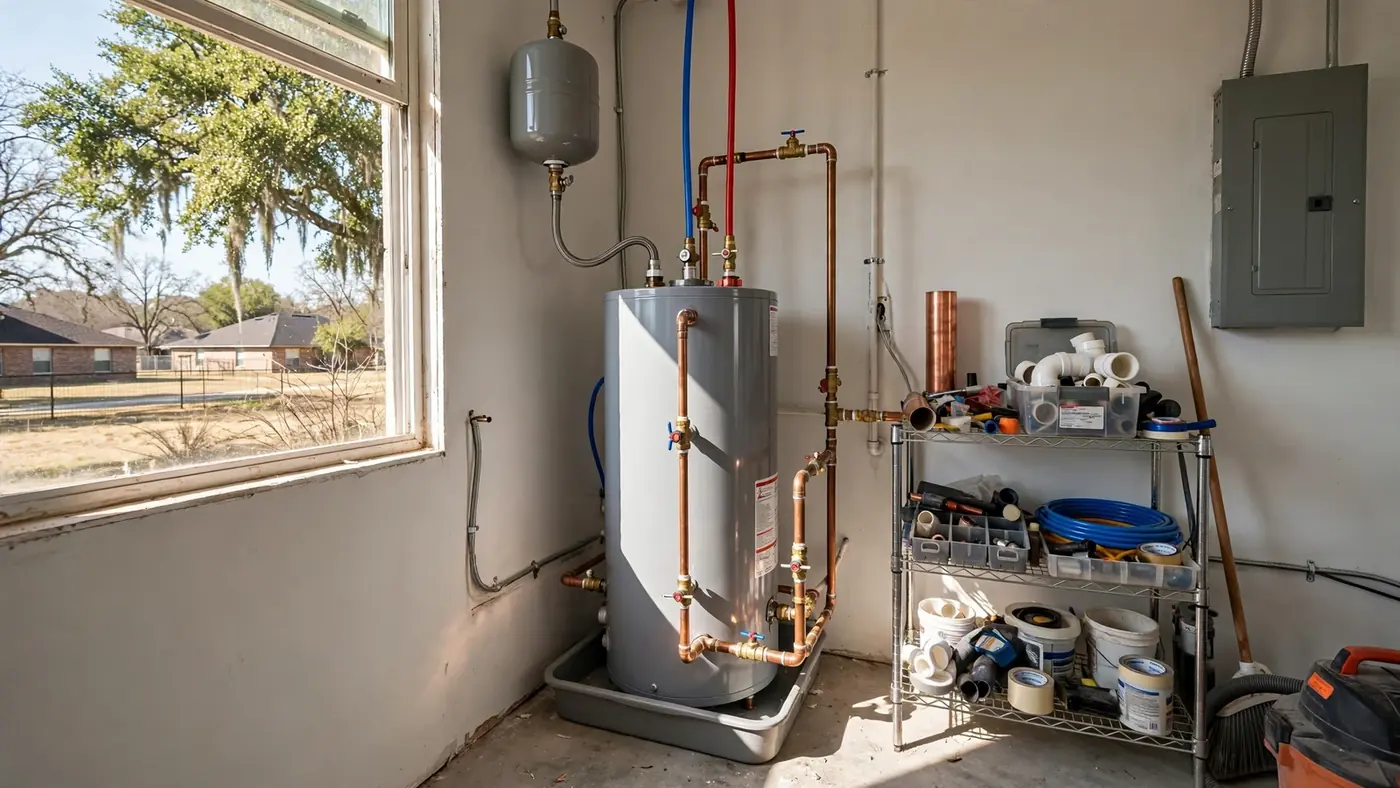
When installation is a planned job
Not every installation follows a failure. A remodel that moves the laundry room, a garage conversion, a new addition or a house under construction all need a water heater installed on purpose. So does a home where an old unit sits in a cramped attic and you want it moved to a safer spot.
Planning helps. You can pick the type, confirm the space and electric or gas supply and have permits in place before the work starts. If your current unit is already leaking, see water heater replacement, which is the faster path.
What goes into an installation
Parts and checks on every install
- Correct size tank or capacity for the household.
- Drain pan with a safe drain line to the outside.
- New temperature and pressure valve and discharge pipe.
- Thermal expansion tank on closed systems.
- Shutoff valves and flexible connectors.
- Vent connection and combustion air for gas models.
- Electrical circuit check for electric and hybrid units.
We label shutoffs and show you where they are. The first time a pipe leaks, you will want to know which valve is which.
Where Florida homes put water heaters
Many Winter Garden homes place the heater in the garage or an attic closet. Garages are easy to reach and tolerate drips better. Attics are cramped, and a leak can reach the ceiling below. Because of that, the pan and drain line matter more in an attic, and some owners choose to move the unit to the garage during a remodel.
Heat pump models need air to work. They pull heat from the surrounding space, so a closed closet is a poor place for one. We check clearance and venting needs before recommending a hybrid unit.
Gas, electric and hybrid: choosing before you buy
| Choice | Strength | Watch for |
|---|---|---|
| Electric tank | Simple and common here | Higher running cost than a heat pump model. |
| Gas tank | Fast recovery | Needs gas supply and venting. |
| Hybrid heat pump | Lower electricity use | Needs space, airflow and a condensate drain. |
| Tankless | Compact and continuous supply | Needs sizing and, for gas, proper venting and gas line capacity. |
We give you the cost factors and the number before we begin. Planned installations are scheduled when we have an appointment available.
What the installation day looks like
We confirm the unit and parts before we arrive so the work is not stopped by a missing fitting. The technician shuts off water and power, drains the old unit if there is one, sets the new heater on a pan, connects water, vent and power or gas, and fills and purges the tank before the heater is switched on. A heater that fires on an empty tank is ruined in minutes.
We test the temperature and pressure valve, check every connection for leaks and set the thermostat to a safe temperature. Then we walk you through the shutoff valves and the controls so you know what to do the next time something drips.
Permits and inspection
A new installation typically needs a permit and an inspection. The Winter Garden building division handles permits from 300 W Plant St, and work done without one can draw code enforcement and extra fees. We manage the steps we are responsible for. For a large remodel, the general contractor may pull the permit and we coordinate with them.
We also install in Windermere and Horizon West. For a tank that is leaking today see water heater repair.
Installations follow the Florida Building Code, Plumbing and the maker's manual, and gas models also follow NFPA 54, the National Fuel Gas Code.
Questions we hear from callers
As early as you can. The unit, any permit and your access all affect timing. Call and tell us the type of heater and the location, and we will give a schedule.
Often yes. It needs new supply and drain lines, a vent for gas models and power for electric ones. We explain what the relocation involves.
On a closed system, such as one with a backflow device or pressure regulator at the meter, usually yes. It protects the tank from pressure swings. We check the system.
We handle the permit steps we are responsible for and tell you what the city needs from you.
We can discuss it. We install units we trust and explain the warranty implications of supplying your own.
Yes, in coordination with the builder or general contractor, on their schedule.
To plan an installation, call (407) 964-8940.